
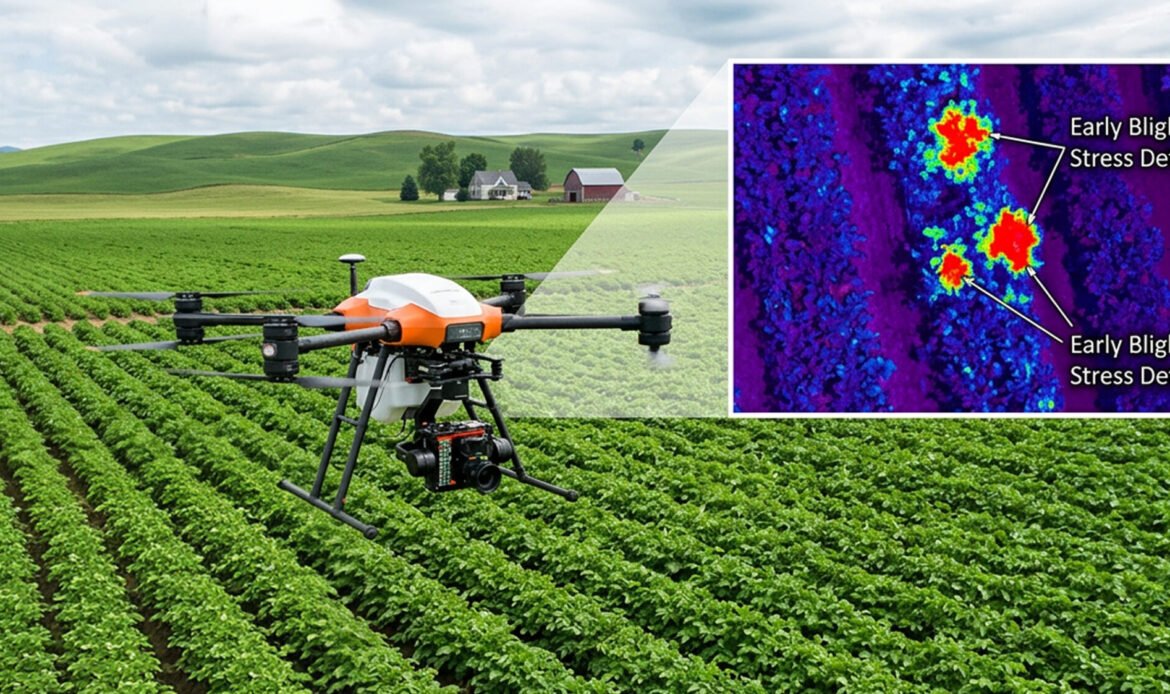
The health of crops is crucial for high-quality production in agriculture. However, conventional methods of tracking diseases are often troublesome. These methods are usually unable to identify early-stage infections. In contrast, hyperspectral imaging drones provide precise and non-invasive solutions for early disease detection.
Moreover, reflected light analyzed across various wavelengths can help crop producers minimize losses and reap better profits. According to recent research, it could detect plant stress up to 10 days before visible symptoms appear and, therefore, is a vital tool of modern agriculture,
This blog will discuss how hyperspectral imaging drones are beneficial in agriculture, their costs, and future potential.
What is Hyperspectral Imaging in Agriculture?
Hyperspectral imaging is used in agriculture to collect spectral data across hundreds of bands and measure even the slightest changes in plant physiology. In comparison to traditional cameras, hyperspectral sensors can detect specific plant stressors that manifest when plants are diseased or under nutrient or water stress.
As a result, hyperspectral remote sensing technology has gained momentum in precision farming, especially for sensitive crops such as herbs, spices, and leafy greens. Consequently, this imaging enables farmers to monitor crops and take necessary actions at the right time to prevent disease outbreaks.
How Hyperspectral Imaging Drones Work
These cameras-mounted drones scan fields to take detailed spectral information. It works in the following steps:
| Component | Function |
| Hyperspectral Sensor | Captures detailed spectral data from plant surfaces across multiple bands. |
| Drone Platform | Provides aerial mobility to cover large fields quickly and efficiently. |
| Data Processing Software | Analyzes spectral data to detect anomalies indicative of plant diseases. |
Drones can even indicate the exact areas of infection to the farmers, which leads to proper treatment and thereby saves waste.
Advantages of Hyperspectral Imaging for Plant Disease Detection
- Early Detection: Hyperspectral imaging can detect crop stress up to 10–15 days in advance compared to traditional visual inspection.
- High Accuracy Rate: Spectral data yields accurate knowledge of the plant’s health; the chance of a false positive is also lower.
- Cost Effective in the Long Run: Indeed, as a hyperspectral camera may be expensive at the onset, subsequently, there will be enough savings from saved crops that might otherwise have gone down to disastrous diseases.
- Scalable Solutions: These drones can observe plants whether they are small herb gardens or quite enormous spice plantations.
Applications in Herbs, Spices, and Leafy Greens
| Crop Type | Disease Detected | Hyperspectral Advantage |
| Basil | Fungal infections | Discovers the first symptoms of infection before leaf discoloration. |
| Spinach | Powdery mildew | Determines mildew stress via identifying specific spectral markers. |
| Coriander | Bacterial leaf spot | Allows the automatic detection of bacterial infections, without causing harm. |
| Saffron | Fungal wilt | Monitors conditions of the soil and plant together |
Hyperspectral imaging has proven to be especially effective in monitoring high-value crops, such as:
Cost and Features of Hyperspectral Cameras
Hyperspectral cameras offer advanced capabilities for plant monitoring, but their cost varies based on specifications and technology.
| Aspect | Price Range (INR) |
| Price Range | Typically USD 9,000 to USD 90,000 |
| Specifications | Ranges like 400-1000nm, 900-1700nm, 400-1700nm |
| Affordable Options | Some low- and mid-range models available |
| High Cost Reasons | Advanced technology, high precision, and quality control add to the cost. |
(Source)
These costs may seem high, but the returns on investment are obvious: higher crop yields, less waste, and higher market value for disease-free crops.
Challenges and Limitations
There is, however, an unfavorable aspect of hyperspectral imaging, namely:
- High Initial Costs: Hyperspectral cameras can be prohibitively expensive to foster widespread use among smallholder farmers.
- Data Complexity: Such large volumes of spectral data require powerful software and personnel training.
- Weather Dependence: Cloud cover may hamper drones from functioning and, by extension, data quality.
It can bridge such problems with the likes of cloud-based analytics platforms, including Aerial Brain, by simplifying data management and interpretation.
Future of Hyperspectral Imaging in Agriculture
The future of hyperspectral imaging in agriculture is promising. As the technology advances, we can anticipate
- Lower Costs: The cost of hyperspectral cameras is decreasing as more are being used.
- AI Integration: It would streamline the process of processing complex spectral data with artificial intelligence.
- Wider Adoption: With affordability improved and even user-friendly systems, small-scale farmers can access the technology.
The integration of hyperspectral imaging sensors into drones is soon going to redefine the agricultural landscape by providing scalable solutions for disease monitoring and yield optimization.