
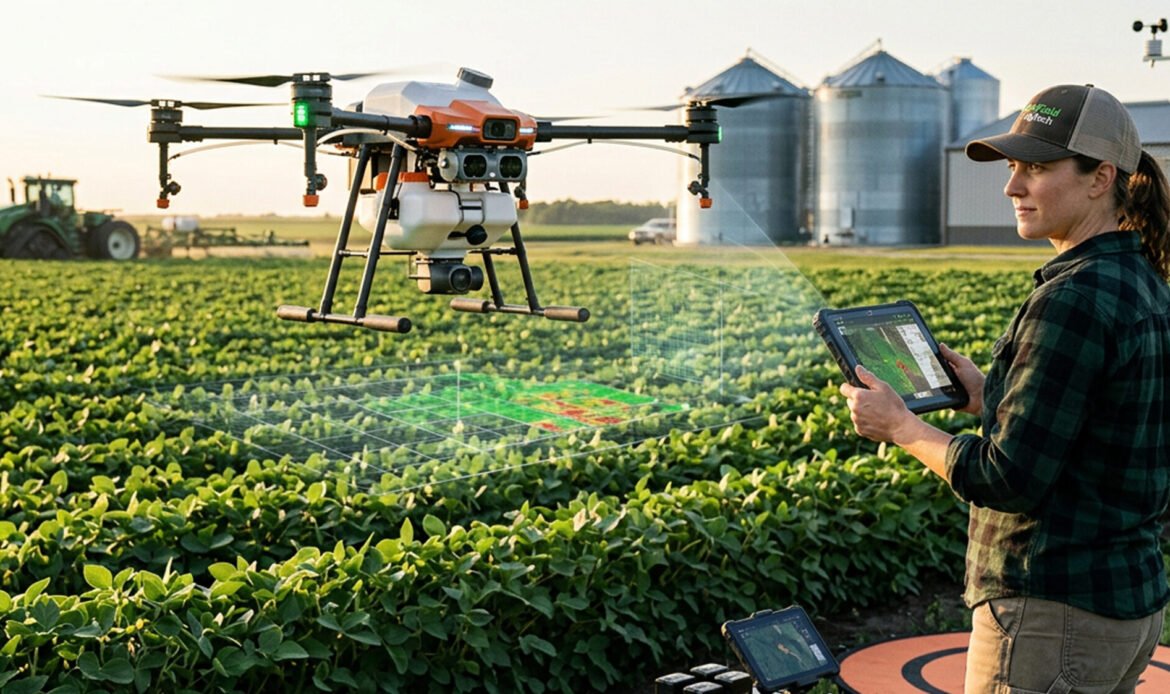
As technology transforms agriculture, drones and farms are becoming interdependent. Drones as an emerging technology have become an indispensable aid in modern farming. Their ability to collect high-resolution data and monitor crops while performing autonomous operations is now changing the terms of agricultural practices.
Below are some of the ultimate roles through which drones and farming are making a difference:
How Drones and Farming are Revolutionizing Agricultural Practices
Technological advancement brings drones and farming closer like never before. Drones refer to unmanned aerial vehicles. They form an essential aspect of farming in modern-day agriculture. They are bringing about tremendous changes in the mode of farming all over the world with their capacity for collecting tremendous amounts of data at high resolution while monitoring crops and flying in autonomous conditions.
Here are a few leading ways these crops and drones have changed the face of farming:
- Precision Agriculture
The implementation of precision agriculture using drones is perhaps one of the most remarkable benefits of drones and farming. A UAV fitted with high-tech sensors can be used to determine, in real time, the soil health, crop condition, moisture level, and possibly other factors that affect growth. This productivity data would get the farmers into the critical decisions on the use of irrigation, fertilization, and pest control, reducing wastage in resource allocation.
- Crop Monitoring and Health Assessment
Water conservation is increasingly important in drought-stricken areas. When it comes to water management, drones and farming can be blended into potent tools. With a thermal and multispectral imaging camera, you can determine which part of a particular field hides evidence of over-watering or under-watering. By mapping out those parts of the field, farmers adjust their irrigation system, thus avoiding water and financial wastage.
- Improved Irrigation Management
Drones and farming work very well in monitoring crop health. Drones can quickly monitor thousands of acres of farmland. High-resolution cameras and sensors mount these UAVs, giving instant, detailed crop and soil images, thus helping farmers to identify early-stage challenges such as pests, diseases, or nutrient deficiencies, if any. Timely intervention would eventually require less use of broad-spectrum pesticides or the loss of crops.
- Crop Spraying and Fertilization
Drones and farming are further being implemented into crop spraying and fertilization. These UAVs have, in fact, changed the way farmers apply pesticides, herbicides, and fertilizers. Instead of spraying a whole field, the farmers can fly precisely to some parts to reduce the volume of chemicals being used. Thus, the environmental effects will also be reduced, making it healthier for crops and enabling farmers to save money.
- Yield Prediction and Harvesting Optimization
On-the-ground technologies for measurement, like drones and farming, will enhance farmers’ accuracy in forecasting production. By analyzing plant growth, soil conditions, and various environmental conditions, drones assist in plant growth forecast and planning accordingly in time. The harvesting methods may also improve through technology by recognizing the exact time to pick crops, thus decreasing waste and increasing profit.
Drones and Farming: Key Metrics and Benefits
This table outlines essential insights into drones and farming practices. It showcases drones’ cost-effectiveness, advanced features, and impact on productivity and farmer safety.
| Aspect | Details |
| Revolutionizing Farm Spraying | Drones enable automated pesticide spraying, reducing health hazards, saving time, and minimizing labor. |
| Cost Efficiency | Renting a 10 kg payload drone costs ₹350-450 per acre. |
| Improved Productivity | Covers 30 acres daily with six hours of operation. |
| Time Savings | Drone sprays: 5-7 minutes/acre; Manual sprays: 3-4 acres/day. |
| Reduced Input Costs | 25-30% savings on pesticides, e.g., nano urea reduces input costs significantly. |
| Water Conservation | Saves 80-90% water due to smaller droplet size (50 microns vs 500 microns in manual spraying). |
| Optimized Drone Design | – Tank capacity: 10 liters (10 liters water + 1 liter spray) – Weight: 12-13 kg (empty), 25-27 kg (loaded). |
| Flight Parameters | – Range: 500 meters (freeze limit) – Height: 30 feet (freeze limit for safety). |
| Emerging Innovations | Future capabilities include spraying pellets, powders, and seeds. |
| Advanced Features | – Obstacle radar for navigating wires/poles – Terrain radar for automatic height adjustment – Flow meter ensures auto-return for low battery or depleted spray – Night vision for nighttime spraying. |
| Farmer Health and Safety | – Reduces respiratory disease risks for ~0.3M farmers – Minimizes snakebite risks (58,000 deaths/year). |
| Economic Viability | Purchase cost: ₹7-9 lakh (₹700,000-900,000); Renting cost: ₹600-700 per acre. |
The Impact of Drones and Farming on Environment
Drones and farming offer smart solutions to numerous environmental problems confronting farmers today. Precision agriculture addresses chemical and water overuse, making farming more eco-friendly. With drones monitoring plant health and growth, and reducing strain on the soil, farmers can minimize soil compaction and preserve habitats, creating space for diversity in agricultural landscapes. Drones in farming have the potential to go much further than they currently do. As technology advances, drones are becoming increasingly autonomous, smart, and economical.
Drones are already making decisions on their own based on the data they collect. Human intervention is less needed, and in the future, drones may be used to plant seeds, provide real-time data analytics, and create detailed soil maps for customized farming practices. We will soon see drones integrated with other emerging technologies, such as robotics, machine learning, and IoT. Together, these technologies will help farmers run their operations more efficiently and sustainably.